
Reporting and research have the same purpose: the assembling of facts. Reporting is associated with journalism and the practice of obtaining information for use in many ways. As a term, research suggests more depth, the excavation of facts with enough range to support narratives or render judgments.
Reporting and research make up the core of every fact-based book. And like all other aspects of writing, the way that this work gets done can range from cursory to prodigious.
Reporting means asking or raising a question. The proposition is straightforward. The practice is more complicated. The place to start is to ask what it is you want to know, and in what detail.
For example: Who struck John? Where, when, and why? What was the result? According to whom? How do you know the answers are true? Can you list the sources? By name? And how did you go about getting all of the above?
Good reporting is an acquired skill. The more of it you do, the better the outcome is likely to be.
State the proposition: John was struck. You want to know everything about the incident. The perpetrator should be identified, and if there was a wrong or a reason, what was it? If there is a complete answer to the question, what would that mean?
And after the first round of questions and results, be prepared to go back, and back again.
Reporters should be relentless. Don’t succumb to comforting satisfaction. Great reporters are curious to begin with and suspicious by nature in their quest for accuracy and, ultimately, truth.
Then there is note taking and organization. Every reporter and researcher has to devise techniques that work for their individual style. The universal mantras are trial and error, patience and persistence.
Simultaneously writing notes by hand while interviewing a person can lead to illegibility. But there are now an array of devices that will retain whatever is being heard or discovered. Relying on technology for taking notes and retrieving them can be efficient, but only after you have made sure to know what you are doing and how not to make a mess of it.
The traditional way to do this was to employ techniques like touch typing and shorthand, at one time a reporter’s best tool. I never conquered either skill. It is amazing how much you can get done with two fingers on a keyboard.
People are inherently unreliable. That is human, often excusable, and mistakes once revealed can be rectified. Crossing out, revising, and updating are honorable. My determination has always been to find the best way to preserve and decipher what my reporting has produced.
The transition from primarily analog reporting and research to digital has obviously made a massive change in the amount of material accessible without really ever leaving a chair. That is an enormous asset, especially to research.
But technology can be unforgiving. Hitting the wrong key in moments of inattention can cause material to be sent to the wrong recipient or to disappear altogether.
Like learning a language or playing an instrument, knowing how to use digital file systems takes time. For most people transitioning from analog methods, it is not automatic or intuitive.
The rules of technology are not always logical. When, a very long time ago, I realized that to turn OFF my Windows program, you click on START, I got the drift.
By comparison, analog note taking and organization is cumbersome. And what if all those notes get lost in a flood or a fire?
Here is my suggested solution. Whether you go digital or analog, make a copy of everything and put it in a safe vault, or with instructions for retrieval shared with a reliable backup. That way, if all hell breaks loose, the material can be found and printed out.
Belt and suspenders.
*********************
Reporting is required for any story. Investigative reporting and writing is a specialty, like rocket science or complex surgery.
The investigative reporters I have known and edited are fierce — not necessarily angry, although that can help. They will pursue a story until the revelations are convincing enough to withstand challenges and denials.
Investigative reporters deploy skills at accounting, deciphering small print, and obscure data discovery with a determination to gain the trust of sources, recognizing that almost always there are people who don’t want you to find out what they have hidden or, more often, covered up.
They need to be prepared for what at the Washington Post we called “non-denial denials,” which dispute but don’t refute the facts. Those on the receiving end of investigations rarely want to accept or confirm the disclosures.
Investigative writers need to be self-confident, just this side of arrogant, and need to have editors and publishers who will support them.
And this: investigative books have very little latitude for making mistakes. Fact checking is obligatory, down to the spelling of every name and the precision of dates. The smallest error requiring a correction tends to undermine everything else.
Investigative reporting has a distinguished history. The early twentieth-century “muckrakers” transformed whole industries with their work. It was later in the century when writers like Bob Woodward, Seymour Hersh, and Jane Mayer dissected politics and politicians that books became a crucial factor in exposing corruption and, along the way, leading to the erosion of trust of leaders and the institutions of government.
I will choose one book to exemplify the best of investigative writing and publishing: John Hersey’s Hiroshima, which appeared initially as a full issue of The New Yorker in 1946 and then as a book from Alfred A. Knopf.
The atomic bombing of Hiroshima and Nagasaki is credited with bringing World War II to a close and opening the nuclear age, in which it became possible to use weaponry to obliterate entire cities and beyond.
In the months after the attacks, the U.S. political and military leadership were able to limit the information and public awareness of how devastating the bombs had been on the civilian population of the two Japanese cities. To some extent, relief that the war had ended made it easier for the American people to ignore the suffering of a defeated enemy.
Hersey, already an admired war correspondent, got access to Hiroshima, where he focused on six survivors of the bombing. The writing was unadorned, which actually increased its impact.
The establishment recoiled.
Many millions of copies have been sold, and eighty years after it first appeared, the book is still for sale in seven formats. At Amazon it is often number one in the category of Japanese history. Nuclear weapons have never been used again.
**********************
Occasionally, one example explains a much broader insight. That was my reaction when I heard the historian Craig Fehrman on a panel talking about his well-received book, This Vast Enterprise: A New History of Lewis and Clark. Here is what he said:
My number-one tip on research is to just follow every lead, every single lead. Don’t worry about how long it’s taking. Don’t worry about the story; follow every lead. . . .
I’ll give you a really quick example; [William] Clark’s college notebook. That’s one of the biggest things I found in my book — that Clark actually went to college. Most books about Lewis and Clark would make fun of him. And that’s not true; he was very well educated.
I found that out while I was doing research for York [a Black slave accompanying the expedition], because York wasn’t able to read or write, so I was trying to read everything related to York I could, and I knew that there was an autobiography written by a white person who had a Black slave in Kentucky. And so I was like, I’m going to read this, just to find out about that Black slave in Kentucky, so I can understand York. . . . And on the first page, the guy says, “I headed back with my good friend William Clark.” And I’m like, That William Clark?
So I had to do a little bit of research to verify it, but because I was looking at every single thing I could find about York, I found something really big and new about Clark, because that autobiography talked about him going to college, and that started me down a really long process.
So in terms of when you have enough, you never have enough. You’ll never feel like you’re ready. But what you need to do is chase down every single lead, because you never know. The one question that you’re trying to answer, that might open up something else.
Reporting and research have no designated boundaries or limitations. Rendering what you learn and then writing it to be understood and appreciated are actually different parts of the process. Great material in the rough can lose the intended meaning.
This takes us back to where we started, the writing process. Taking the information that you have amassed and producing a publishable work deploys an array of skills. Ideally, a writer develops all the necessary ones. My sense is that wherever you start, you’ll want to continue to refine the ability to attract readers — which, after all, is the objective of writing.

The debates over abortion and the racial integration of schools have long been at the center of American life and politics. On that we can all agree.
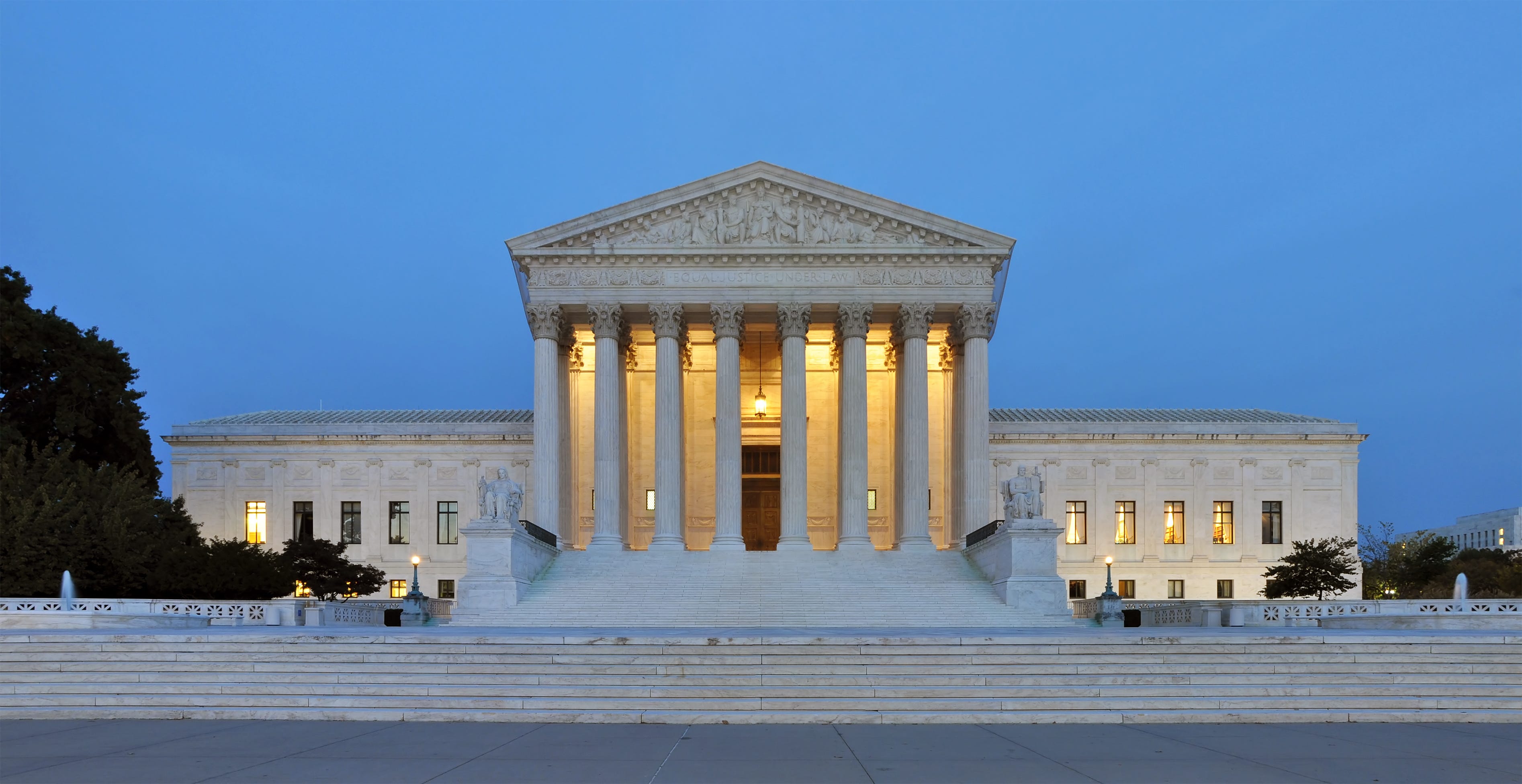
In 1973, the Supreme Court established a constitutional right to abortion in Roe v. Wade. In 2022, the court ended that federal mandate for access to abortion, returning the issue to the states.
In 1954, the Supreme Court in Brown v. Board of Education banned official segregation in schools and in an implementation decision the following year said that integration should proceed “with all deliberate speed.”
Well, it turns out that since the 2022 decision, the number of abortions per year in the United States has increased by about 21 percent, compared to the Guttmacher Institute’s statistics from 2020.
And by all accepted measures, the number of American public schools where the student body is 90 to 100 percent non-white has tripled over the past three decades. In Mississippi, for example, the number of racially integrated schools is statistically negligible.
In major cities like New York and Chicago, public school enrollments are drawn overwhelmingly from Black and Hispanic minorities.
I had been hearing about these figures for some time, but I only recently looked into them and began to wonder why the realities were so different from what these judicial decisions would have them be.
It is safe to conclude that while court rulings and legislation set the official terms for society, they plainly cannot overrule popular will and preferences.
********************
According to the Guttmacher Institute, seventeen states have now banned abortions in almost all cases. Overall, thirty-six states have rules that deal with the circumstances and timing around abortions.
The main reason for the substantial increase in abortions is the widespread use of medication, as distinct from surgery, to end pregnancies — a choice that more women are making today because they live in states where surgical abortion has become difficult to obtain. Almost two-thirds of abortions involve the drug mifepristone. Medication abortion has been unsuccessfully challenged in court by anti-abortion activists, though it remains banned in those states whose laws mandate against abortion induced in any way.
It has been more than forty years since mifepristone was developed in France, and it is now widely prescribed around the globe and is regarded as safe and effective.
Yet the divide between anti-abortion activists and supporters of a woman’s right to choose remains enormous, despite the reality of how many abortions are performed and how the procedure has evolved.
And to be clear, for women in the seventeen prohibitive states, the issue of abortion is incomparably worse than it was.
The considered judgment among those qualified to make one is that the issue of abortion has always been much more a spiritual matter about the definition of when life begins than it is about the medical risks and consequences.
In the 1990s, the essayist Roger Rosenblatt, at the instigation of the editors at Times Books, extensively surveyed the subject for a book called Life Itself: Abortion in the American Mind. His conclusion (with which I have come to agree) is that whatever your opinion on the politics of abortion, the consensus is:
“Give abortion five seconds of thought and it quickly spirals down in the mind to the most basic questions about human life to the mysteries of birth and our relationship with our souls. . . . To create a society in which abortion is permitted and its gravity appreciated is to create but another of the many useful frictions of democracy. Such a society does not devalue life by allowing abortion; it takes life with utmost seriousness, and is, by the depths of its conflicts and the richness of its difficulties, a reflection of life itself.”
And so it seems that this insight is the reality, rather than the laws.
*************************
On the matter of school integration, it has become clear over time that despite the benefits of racial balance, it is only possible if everyone involved can agree on how to make it happen. From the outset, there have been clashes over school busing and the redrawing of school districts that eventually overwhelmed the advocacy and virtues of integration.
There are other factors, aside from access, that have defined the way integration has largely failed.
While the population in the United States has undergone a racial transformation over the years, group identity remains strong. Legal discrimination has largely disappeared (on voting rights, the recent record is terrible), but major segments of the population prefer their “own kind.”
African-Americans have been notable in their pride in Black institutions and organizations, colleges, businesses, and bookstores, as well as their prevalence in music and culture, football, and basketball. I am in no position to explain how and why this has happened, but from my perspective it has.
Nominally, everything is open to all comers, but the numbers show that integration on a mass scale has fallen far short of its optimistic projections.
Schools are a particularly complicated issue. A lengthy, heartfelt piece in the New York Times by Nikole Hannah-Jones, a leading Black writers, recounts her daughter’s experiences fulfilling her parents’ ambition to support schools where minority and students from poorer homes dominate. Hannah-Jones reflects the conundrum faced by all urban parents committed to public education: What is the best choice for the child that is also supportive of society’s broad belief in schools integrated by race and family background?
So many years after the end of segregation by law, it is still a reality in schools. As has happened regarding abortion, it remains true that you cannot override what the people choose when they can.
*********************
Do I have an answer to the problem that Hannah-Jones and her husband confronted? No, because I was never tested. Here, with acknowledged humility, is a possible approach:
They could have offered their daughter the opportunity to transfer to a different school, to get the education she said she wanted. Also, they could have devoted their own time and resources to improve the school that was left behind.
Would that have made a difference? Certainly to her daughter and possibly also to a school that so badly needs help.
Publishers Marketplace, founded in 2001 by Michael Cader, is an invaluable resource for the world of books. A full subscription costs $30 a month, and thousands of people choose that. (There is a free option, with limited information.)
Being the impresario, Cader sets the tone — occasionally acerbic — and makes the rules for what gets covered or listed. But Publishers Marketplace is considered as accurate as it is possible to be in a data-driven universe.
The venerable Publishers Weekly maintains a print magazine and a daily newsletter with a variety of price options. Choosing the one that will meet your needs can add up to almost $300 a year at full price. Both publications report the news and comings-and-goings in and around book publishing.
A major feature of Publishers Marketplace is a list of the latest acquisitions, submitted by literary agents and publishers, with each entry containing a brief description and an estimate of the size of the advance, which is an imperfect measure of the book’s expected sales potential. A “nice” deal is an advance of up to $49,000, growing to a “major” deal of $500,000 and higher. Every Monday, subscribers receive an email listing the previous week’s new acquisitions, often numbering in the hundreds.
These deal listings are divided into multiple categories. For fiction, they range from literary to romance and sci-fi; children’s books are classified by age group (picture book, middle grade, young adult); and poetry is its own classification. This is the nonfiction category list, to provide a sense of the spectrum of genres.
Advice/Relationships/Self-Help
Anthology
Biography
Body, Mind & Spirit
Business/Finance/Economics
Culture/Pop Culture
Diet
Food/Beverage
General/Other
Health/Medicine
History
How-to
Humor
Illustrated/Art
Lifestyle
Memoir
Narrative
Parenting
Politics/Current Affairs
Reference
Religion/Spirituality
Science/Technology
Sports
True Crime
The purpose of this chapter is to give writers a sense of the many definitions of what can be considered a book. Writing is a creative act, and as with all creations (meaning to produce something that starts from an idea or vision) there is a genre to be chosen — for instance, abstract painting as opposed to works of art that are figurative or representational, like portraits and landscapes.
Confusing categories can undermine the content. So, consider this list a guide to the many genres of nonfiction.
At my request, Cader agreed for me to use five examples of submissions, chosen from the deals posted in January 2026. These are drawn from categories that are different from those like memoir, biography, and history that I am dealing with in detail. They provide a glimpse of the range of writers’ interests and hopes.
Advice/Relationships/Self Help
Artist and founder of the Introvert Drawing Club Beth Spencer’s untitled guide to accessing creative joy — thereby sharpening focus, lifting one’s mood, and even banishing anxious thoughts — using prompts, mindse, check-ins, and illustrations, to Katie McClimon at Simon Element, in an exclusive submission, by Laurie Abkemeier at DeFiore and Company (world).
Body, Mind & Spirit
The team behind the newsletter, podcast, and community The Small Bow’s THE SMALL BOOK: RECOVERY STORIES FOR EVERYONE, essays and reflections on sobriety, mental health, and whatever else is bringing you down, to Madeline McIntosh at Authors Equity, in an exclusive submission, for publication in January 2027 (world)
Culture/Pop Culture
Columbia University professor of English and comparative literature and author of SCREAM WITH ME Dr. Eleanor Johnson PhD’s MOTHER OF FRANKENSTEIN, a series of close readings of elements of Mary Shelley’s novel FRANKENSTEIN to highlight how and why this novel has such enduring and uncanny purchase on the American imagination, again to Kate Napolitano at Atria, by Charlotte Cohen Sunderland and Celeste Fine at Park, Fine & Brower Literary Management (world).
Food/Beverage
International Oyster Sommelier and cofounder of the Oyster Master Guild Julie Qiu’s THE OYSTER PALATE, a guide to understanding the complexities behind the flavors of oysters from all over the world, blending firsthand tasting experience and marine science, revealing how geography, water chemistry, time, and climate shape the taste of every shell, to Nicole James at Rock Point (world).
Health/Medicine
Today Show fitness expert Stephanie Mansour’s DO WHAT YOU CAN, pitched as ATOMIC HABITS for feel-good health, a guide for anyone who has ever abandoned a lofty wellness goal — from fitness to nutrition, sleep and even emotional regulation — offering science-backed “mini win” strategies for lasting holistic health, to Ashley Di Dio at Putnam, at auction, for publication in spring 2027, by Abby Walters at CAA (world).
Authors clearly come to the process with varied intentions. The point, again, is that each of these projects begins with a writer whose ambition is to publish a book that will make an impact, hopefully endure, and make money, where that is the objective.
In 2025, more than four million books were published in the United States, the majority of which were “self-published” or “hybrid,” meaning that the author paid at least in part for the print run and digital presence. While these books have become an increasingly important part of the publishing universe and can sell in large numbers, Publishers Marketplace and the review media have yet to fully recognize their importance, a reflection of the outdated notion that this is “vanity” publishing, a topic I’ll address in a later chapter.
More than a half million general-interest, or “trade,” books were released by publishing companies, small, medium, and large, which acquire, edit, and market the books.
Among these, the number of successes measured by sales, acclaim, and full author satisfaction with the results and with the publisher’s efforts, is actually a small fraction of the total.
But they all have a common origin: a writer, an idea, and persistence through the writing process. Reporting and research are the essential components of composition, no matter the subject or the publishing format in which they will ultimately appear.
That will be the focus of the next chapter.
************************************
Thursday Oct. 8 at Politics and Prose 5015 Connecticut Ave. NW 7 pm. In conversation with Kenneth Feinberg, Special Master of the September 11th Victiim Compensation Fund and author of “What Is Life Worth.”

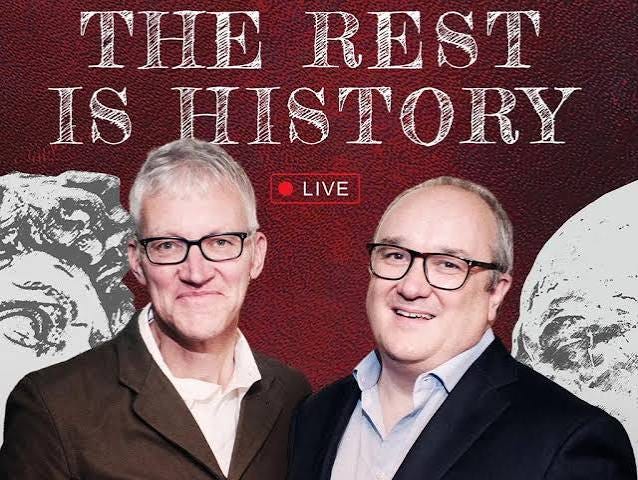
The podcast “The Rest Is History” does for history what “Car Talk,” a much-loved and much-missed NPR program, did for automobile mechanics — a conversation between experts, as erudite as it is entertaining.
The hosts are Dominic Sandbrook and Tom Holland, historians who share the skill of combining storytelling with detail that supports but does not overwhelm the narrative.
The podcast was launched in November 2020, has released roughly eight hundred episodes, and has had tens of millions of downloads. It is a certified blockbuster, as described in this admiring feature in the New York Times.
After multiple recommendations, I started listening to it in the car over the summer and have now added it to my daily intake of added knowledge.
I have been through the Battle of Trafalgar, the Battle of Hastings, the destruction of Carthage, various chapters on the rise and fall of the Roman empire, and, as a sort of change-of-pace, the sinking of the Titanic.
The preponderance of conflict and violence in these sagas is more than coincidental. Civilization is framed by the eternal competition for power, territory, religious and cultural primacy, and by the transience of eras.
One notable aspect of the episodes are apocalypses of one kind or another and the destruction of civilizations — or potentially even the human race. Historical deaths in individual or aggregate numbers are almost always mentioned.
Death counts are also a staple feature of local broadcast news — “if it bleeds it leads” is the mantra — while mayhem and annihilation dominate on the movie screens, especially over the summer.
Children in the 1950s (I was one) were trained in “duck and cover” school drills in preparation for a nuclear attack. We wore dog tags with our names on them. Civil Defense shelter signs were everywhere.
The potential for a nuclear war seems to have receded over the decades, although the amount of weaponry maintained by the United States, Russia, China, and a half dozen other nuclear powers is massive. The arms control treaties that have been negotiated, beginning in the 1960s, have largely lapsed or have been overtaken by real and prospective nuclear proliferation in, among other places, North Korea and Iran.
In 2026, the probability that artificial intelligence agents could bring about the end of humanity has been estimated at a 10 percent likelihood. Regulation of this phenomenon has yet to be established by governments or by the companies that have developed what amounts to weaponry.
So the civilizational peril and violence that represent so much of the content of “The Rest Is History” reflects reality.
And yet history also provides a timeline of progress. Over the centuries, the conditions of life have evolved for the better in almost every respect. One of my favorite lines about these improvements is that among the greatest achievements in medical science was soap and water for sanitation, a very long time ago.
We know so much about the past because we have developed increasingly sophisticated ways of preserving the record. AI seems to be the latest iteration of this, perhaps further than it will turn out to be safe to go.
One of the reasons that Sandbrook and Holland are so popular is their ability to relate history to the present — how, for example, the politics of imperial Rome align with the twenty-first century.
They remind us that scandals, corruption, rage, and sex have deep roots in human nature. So it is that violence also is a recurring theme down the generations. In many places (although not yet in the Darfur region of Africa), terrifying men on horseback have been replaced by swarms of drones that kill with little risk to those deploying them, progress of a sort.
Podcasts are proof of continuity in history. Listening to people talking and telling stories is an experience as old as time.
Events then and now are on a continuum. “The Rest Is History” makes that connection, and it is definitely working well.
The essential truth of historical writing is that it is not immutable. History covers and interprets events which over time can be reconsidered.
The history of the United States, as it was understood for most of the past 250 years, was dominated by the role of the founders, Manifest Destiny as the population moved West, the renunciation of slavery in the wake of the Civil War, and the twentieth century of great American power: World War II and the Cold War, ending with the triumph over the Soviet Union.
In 1980, Howard Zinn’s book A People’s History of the United States started the reinterpretation of American history, with its emphasis on social inequality and discrimination. It is still #1 on Amazon’s listings in several nonfiction categories.
In recent years, the conventional narrative has been even more substantially revised. Harvard professor Jill Lepore’s 2018 book These Truths: A History of the United States brilliantly changed the traditional framework by pointing out that the standard perception of the past largely overlooked the half (or more) of the country that were women, Blacks, and Native Americans.
The seminal dates in history remain firm. The Declaration of Independence: July 4, 1776. The start of the Civil War: April 12, 1861. The attack on Pearl Harbor: December 7, 1941. The assassination of John F. Kennedy: November 22, 1963. The attack on the World Trade Center and the Pentagon: September 11, 2001.
But what those dates meant and how events unfolded continue to be reconsidered and revised. History has become much more of a tug of war over narrative than it once was. Historical writing is almost never truly the last word.
As a book editor, I learned this lesson shortly after I arrived at Random House in the mid-1980s.
I mentioned earlier my admiration for the Landmark series of histories by notable writers, books written for the benefit of younger readers that I had so enjoyed. They were largely out of print, but copies were available in a company library, and I thought about reissuing them.
I selected Remember the Alamo! by Robert Penn Warren as the place to start because my assistant, Lisa Kaufman, had worked with James Michener on his epic historical novel Texas, which meant she would have a sense of how well the Landmark book, which had been published in 1958, represented the event. Lisa began to read. Soon, she reported a problem.
Here is how she remembered that experience: The glorification of the defenders and the excoriation of the Mexicans and Indians (as they were then called, sometimes “savages”) had to be updated to contemporary standards. At my request, Lisa contacted the illustrious author, who said he was embarrassed by the racism and would, for free, do the revision.
In the meantime, as we examined other titles, we concluded that these works of history, written in the 1940s and ’50s, probably would not withstand scrutiny of their language and judgments decades later.
Chagrined, Lisa had to tell Robert Penn Warren that we had decided to abandon the idea of relaunching the Landmark series.
*********************
As with biography, history has to be judged through the prism of the author’s expertise and point of view. These books are simply one person’s (or a collaboration’s) conclusions.
Historical writing is rendered in many different styles. Writers with a background in journalism can be well suited to writing history. They are expected to give precedence to facts rather than opinions, with judgments supported by sufficient evidence.
In 1943, Alan Barth, an editorial writer for the Washington Post, said memorably that “news is only the first rough draft of history,” and that is why journalism is so essential to the recording of events.
This has become a credo.
An excellent example of a journalist succeeding as an historian, as I mentioned earlier, is Rick Atkinson, whose two prize-winning series, on the American Revolution and on World War II, reflected his years as a reporter and editor at the Post and are widely admired for their readability.
Atkinson’s self-assessment as a journalist underestimates his now scholarly status and approach. His research is prodigious and his commitment to the facts resolute.
Another example: The great documentarian Ken Burns and his writing partner Geoffrey Ward have amassed a spectacular record of combining imagery and storytelling that is essentially impervious to academic condescension. Their films and books are notable for presenting events and characters from history without the burden of ideology or bias that can undermine histories by even the best of scholars.
University professors may possess unsurpassed knowledge and can source the smallest of details, but sometimes their writing is too dense for the general reader — and that complexity can be confused or justified as erudition.
One of the requirements for acceptance by university presses is the peer review process, in which anonymous specialists critique manuscripts on submission. This is still accepted practice. My sense of this aspect of assessment is that it can undermine original thinking and good writing in favor of reinforcing the accepted scholarship.
The academics’ retort would be that as a journalist I am biased against the standards demanded by these peer reviewers. I don’t expect them to agree with me. Describing and interpreting the past, and as in every other field involving facts, demands that the facts be verifiable — and resistant to challenge. But they must also be accessible to readers.
Another complicated aspect of portrayals of history is how much of it there is. The rise and fall of the Roman empire is a subject of everlasting interest. That saga took place over centuries with a canvas of backgrounds, events, and characters that could and already have encompassed entire libraries of literature.
There are comprehensive histories of the Roman era, but no version I am aware of is so definitive that no further books will be necessary.
Any slice of history can serve as the basis for an expansive story to provide context — even, for example, Lincoln’s Gettysburg Address, a speech of just 272 words, as Garry Wills proved in his wonderful 1992 book Lincoln at Gettysburg: The Words That Remade America. A slice is almost always the basis for something much larger.
For the writer of history, the challenge is to achieve the authority to be taken seriously and to maintain an approach that provides readers with facts, interpretation, and satisfaction.
****************************
My qualifications on the writing of history come from what is generally known as the Vietnam war — or, as the Vietnamese call it, “the American war.”
In the mid-1960s, as the war escalated and opposition developed, I was of draft age but received a deferment because of the lasting effects of a nerve injury in my right hand in a college accident. I thus never had to answer the existential question in my generation of what I would have done if I had been drafted.
I worked as an assistant to I. F. Stone, whose journalism shaped expectations of the likelihood of American failure, because he memorably wrote of U.S. policy makers’ ignorance of Vietnamese history and of their exaggeration of what the threat of communism in Indochina would mean to American power.
Stone’s study of history provided the support that his position on events demanded.
Over the decades, I would become immersed in Vietnam. In 1970, I was sent to Saigon as a correspondent by the Washington Post. The editor, Ben Bradlee, never asked for my views on the war. It was his belief that his young reporter would write what he learned and saw and would not press the case for or against the conflict.
Before, during, and after the experience on the ground, I read widely on the topic. I was in Vietnam when the Pentagon Papers, were published by the New York Times and the Washington Post. Over the years I would refer to this compilation of documents about the shaping of American policy in Vietnam as important source material. My reading on the war included seminal works like Frances FitzGerald’s Fire in the Lake: The Vietnamese and the Americans in Vietnam, which won the Pulitzer Prize and the National Book Award in 1973, and the French journalist Bernard Fall’s brilliant books, including Street Without Joy: The French Debacle in Indochina.
After I became a book editor, I was responsible for publishing books by journalists who offered perspective about the war, among them Morley Safer, Malcolm Browne, Ward Just, John Laurence, and Bill Prochnau.
I was not the editor of Neil Sheehan’s A Bright Shining Lie: John Paul Vann and America in Vietnam, the winner of the 1989 Pulitzer Prize and the 1988 National Book Award, but I consider it the best history of the conflict.
Sheehan was a young reporter for UPI in the 1960s, as the U.S. role in the war deepened. He was one of a trio of reporters — David Halberstam of the New York Times and Malcolm Browne of the Associated Press were the others — who were influential and controversial in framing what proved to be the misbegotten strategies and objectives of American policy.
In the spring of 1972, while I was in Saigon, Sheehan came to Vietnam on a reporting trip, and he told me that he was planning to write a book about Lieutenant Colonel John Paul Vann, who had served as a military officer and senior civilian adviser in the war and had recently been killed in a helicopter crash. When I heard Sheehan talk about the book, my sense was that it could become the classic history of the U.S. in that conflict. He used Vann’s life story as the channel through which the war could be understood. With immense accretion of detail and an immersive writing style, Sheehan achieved his objective.
The Vietnam war was especially notable for how divisive it was: hawks, doves, the anti-war movement, tens of thousands of American deaths, and countless Vietnamese casualties were the core narrative of the conflict. To read Sheehan’s book now, decades later, is to recognize its brilliance. There is not a scintilla of gratuitous judgment or polemic to emphasize the disaster that Vietnam was for the United States.
Great historical writing will always depend on how completely the historian can reach conclusions without falling into the trap of ideology or conventional presumptions.
Over a period of ten years I worked as editor and publisher with Robert S. McNamara, whose years as secretary of defense from 1961 to 1968 made him the most widely blamed figure for the war’s trajectory, although the conflict persisted for seven more years after he left office.
His memoir, In Retrospect: The Tragedy and Lessons of Vietnam, published in 1995, was exceptionally controversial because the general assumption of readers and critics was that McNamara was seeking redemption for his role in the debacle.
In fact, McNamara’s main purpose was to show how the war had gone so wrong because whatever the American intentions may have been, official hubris and arrogance were the sources of the ignominy and defeat, which McNamara acknowledged.
I drew on my experience with McNamara, my years as a reporter, and the other books I had read and published to write my own book, LBJ and McNamara: The Vietnam Partnership Destined to Fail, which was published in 2025.
More than fifty years after the North Vietnamese prevailed in the war, a unified, communist-led Vietnam is a dynamic society that, ironically, has good ties with the United States. It is the U.S. that still bears the scars of the conflict, most notably the loss of belief that America was benign in its policies around the world and would always prevail.
I do not imagine that the Vietnam war will ever be interpreted as a success for the United States, although the worst predictions of its consequences never happened. That judgment is the result of how much work has been done by so many to reach that firm (for now) historical conclusion.
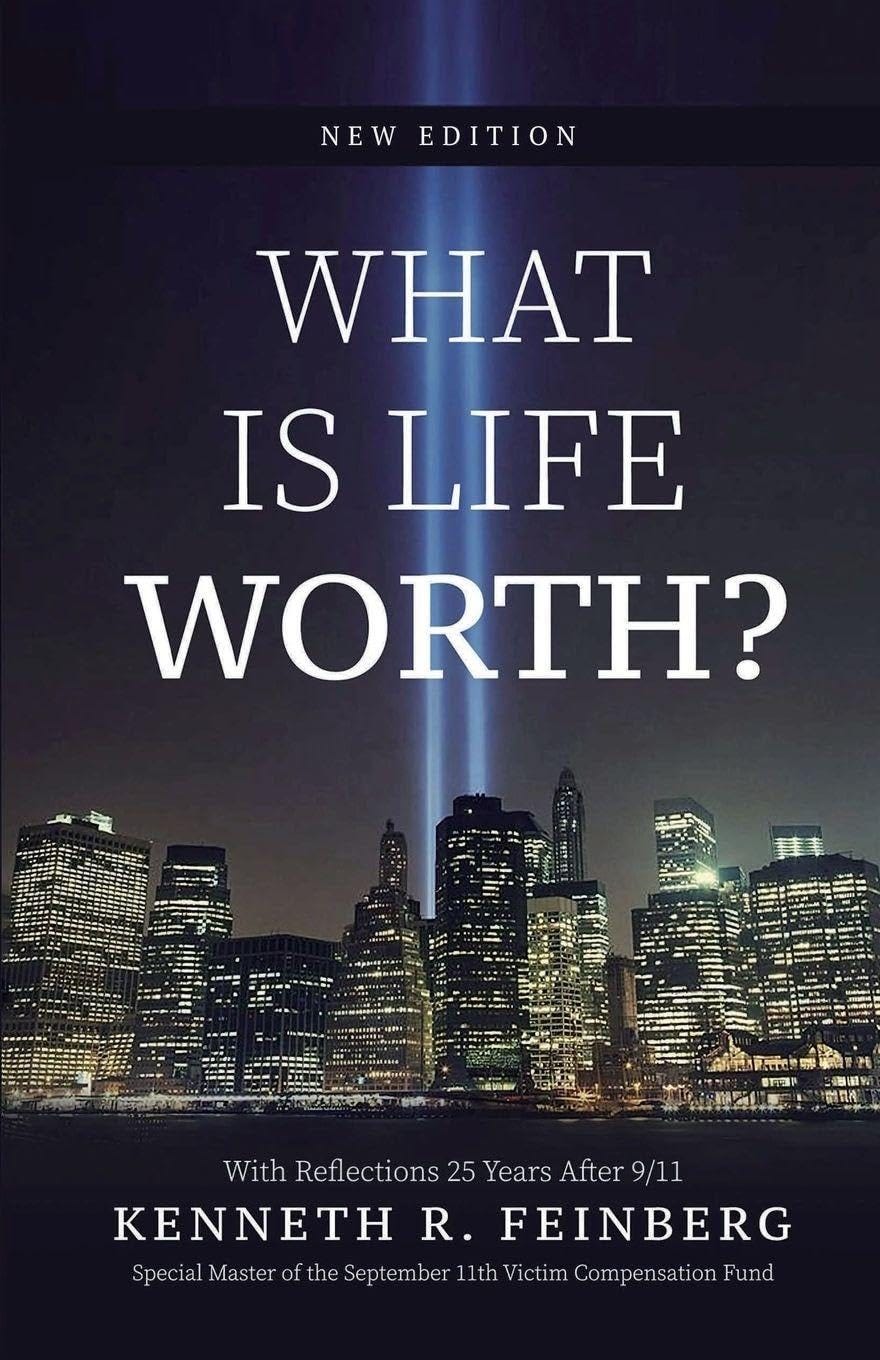
Kenneth R. Feinberg was the Special Master of the Victim Compensation Fund established in the immediate aftermath of the terrorist attacks on September 11, 2001. Feinberg’s book “What Is Life Worth?” has been rereleased featuring his reflections a quarter century after the events. Here is a commentary that Feinberg has written to coincide with the occasion. Please share it widely.
Just thirteen days after the September 11, 2001, terrorist attacks, the Congress and the Bush Administration – working together with a common purpose – established an unprecedented victim compensation fund for over 5,000 victims and surviving family members of the attacks. This compensation was funded entirely by public taxpayer money and sent an important message to the victims and families – you are not alone. The American people would stand united in offering generous compensation and support to innocent victims of terror. “There but for fortune” was a guiding Fund principle. Anyone could be a target of terrorism. Death and physical injury were random results of terrorists attacking individuals who were simply in the wrong place at the wrong time.
American citizens, foreign nationals, even undocumented workers were all eligible for compensation. Ultimately, over $7.1 billion was paid by the US Treasury to the victims and family members.
A critically important feature of the Fund permitted any surviving victim or family member the option of a private meeting with me. These meetings were entirely voluntary and confidential, held behind closed doors. No subject was off limits.
Over 1,500 individuals opted to meet with me or, because of the sheer volume of requests, with a member of my staff. Very few of these meetings focused on compensation. Instead, the confidential meetings provided victims and their families an opportunity to express raw emotion – anger at life’s misfortune and finger pointing at the government for failing to prevent the attacks. Others focused on their frustration and grief that a loved one had perished under the most horrific circumstances without even an opportunity to say goodbye. Others came to the meetings with a different purpose – to validate the memory of a lost spouse, child, or sibling. In these cases, individuals presented me with personal memorabilia including photographs, medals, diplomas and even home movies of happier times. The memorabilia filled my office.
These meetings were extremely emotional, chilling and debilitating. Recesses were frequent and necessary to provide the survivors and families an opportunity to regain their composure. I, too, welcomed the pause before hearing additional stories.
The actual meeting testimony itself bears witness to the emotional atmosphere:
· “They finally found him. They brought his remains home. They had a big funeral service, memorial service and they buried him. Three months later they found that they hadn’t buried him. It was the wrong individual they had been provided. They had to disinter and give to the family the proper remains and then bury him again.”
· “I’m angry. I’m angry. I have to be honest, I am angry with our country also because they let this happen. My beautiful boy was cremated because of them. I never got anything back… if somebody took your child and blew them up and you didn’t have a piece of a fingernail left, how do you live – how do you go on? I’ll never be the same.”
· “She taught me to realize that every day is a choice to be happy or not. She taught me to be present in each moment. They aren’t all meant to be happy. But sadness is as much a part of life as joy, and so the sadness that I feel at losing her is almost equivalent to the joy that she shared with me while she was alive.”
· “The loss is not the greatest for me; I had five years with my husband. I remember having so many dreams where he would come and take our son from me and my husband would say ‘just give me five minutes. I just need five minutes and I’ll give him back.’ And if I could give him five minutes, I’d give him five minutes, because he never had a chance to know his son.”
· “My wife called and I said, ‘Well, thank God, you are okay.’ She said, ‘Well, no, I am not.’ As HR Director, she basically took the responsibility to make sure that everybody got out. She had made a 911 call two minutes before the building fell saying there are eight people up here and, you know, we need to get down. She was still doing her job.”
· “The only thing that disturbed all of us was the fact, in actuality, there was nobody to save. There was nobody to save. What we had been trained to do every day – to mend bones, to patch up wounds, and treat people, that was not to be that day. And it’s amazing to me to think how many EMTs have left the field since then because they couldn’t handle what they remember of that day and have gone on to other things.”
These hundreds of individual stories, spread out over the thirty-three-months of the 9/11 Fund, were critical to success. The individual meetings offered victims and their families an opportunity to express their innermost feelings out of the public eye. They focused on the personal impact of the tragedy and how it affected both their lives and the lives of family, friends, and neighbors. The meetings afforded individual claimants an opportunity to meet with the one government official responsible for administering the program. I believe these meetings helped the victims begin the slow, uncertain healing process by moving forward as best they could.
But these Fund meetings had an important second purpose – they reinforced the idea that America was one community writ large, united in demonstrating support for the 9/11 victims especially in times of tragedy. The Fund reaffirmed the charitable character and empathy of the American people and offered proof of the Nation’s support. In doing this the Fund played a significant role not only in helping individuals cope with tragedy but, as importantly, promoting a type of national healing. In so doing, the Fund has earned a prominent place in American history offering a sense of hope to both victims and our Nation in dealing with the tragedy.
Today, the faith I had twenty-five years ago in embracing the idea of one America, one national community, especially during times of crisis, has succumbed to a new reality. The faith and optimism our Nation exhibited in creating the 9/11 Fund stands in sharp contrast to today’s America. The proclaimed objectives of the 9/11 Fund now ring hollow. Instead, today the 9/11 Fund is either forgotten, ignored or even cited in a perverse way to justify the Trump Administration’s Anti-Weaponization Fund and its shameless raid on the US Treasury.
But I remain hopeful that better days will return and we will once again point with pride to a critical time in American history when the Nation reaffirmed its first principles and exhibited the public character that resulted in the creation and success of the September 11th Victim Compensation Fund.
The attacks on the World Trade Center and the Pentagon on September 11, 2001, were the most aggressive assault on the United States since the Japanese attack on the naval base at Pearl Harbor on December 7, 1941.
While the 9/11 attacks did not lead to a global conflict on the scale of World War II, under the rubric of a War on Terror the United States went to war in Afghanistan, which ended in failure after twenty years, and invaded Iraq, which remains enmeshed in the Middle East’s cauldron of violence and insecurity.
A number of measures were adopted, meant to provide protection from further terrorism on the “homeland,” which on the whole they did. A Department of Homeland Security was established, intended to protect Americans. Now it oversees the persecution of immigrants. The United States has never recovered the sense of security that existed before the lethal destruction in downtown Manhattan and at the Pentagon.
In the aftermath of 9/11, there was one remarkable and extraordinarily positive result: the creation of the September 11th Victim Compensation Fund. It was established by an act of Congress within days of the attacks, and under its authority $7 billion was disbursed to 97 percent of the affected families, as an alternative to litigating individual claims against the airlines and U.S. government agencies.
The shock of the attacks had been so profound that the nation unified in grief and resolution, to respond not only militarily but also with compassion.
President George W. Bush’s attorney general, John Ashcroft, appointed the lawyer Kenneth R. Feinberg to be the special master of the fund, which was notable because Feinberg had previously served as chief of staff to Senator Edward Kennedy. His appointment reflected the federal government’s bipartisan approach to dealing with the crisis.
Feinberg was already known as an expert in mediation and dispute resolution. He had served successfully as a court-appointed special master in a number of prominent cases, including lawsuits against the manufacturers of Agent Orange, the chemical used as a weapon in Vietnam that had sickened American GIs as well as countless Vietnamese. He also mediated cases against the manufacturers of asbestos.
When recruited to the 9/11 fund, Feinberg said that he would work pro bono, without any compensation. He and a small staff met with all the families and reached judgment on individual payments, based on the lifetime expectation of income, which was exceptionally complicated because the victims represented a wide range of income levels, from bankers to waiters to janitorial staff.
I was introduced to Feinberg as the fund was concluding its work, and he agreed to write a book about the experience, published by PublicAffairs, called What Is Life Worth?: The Unprecedented Effort to Compensate the Victims of 9/11. The book later became the basis for the film Worth, released in 2021, in which Feinberg was played by Michael Keaton.
The book has now been re-released, to mark twenty-five years since the attacks, and the new edition includes Feinberg’s reflections on the fund and on how the country might respond today to a catastrophe of comparable scale.
Here is an excerpt:
Would our national leaders step up as they did in 2001 to create a bipartisan fund paid with taxpayer dollars to assist those bearing the brunt of the suffering?
When I look at the political and social landscape of today, I can’t imagine a positive response to this question.
Comparing the America of 25 years ago with the world of today offers a bleak and stunning contrast. Today’s political climate does not provide fertile ground for the creation of programs designed to meet urgent human needs in the fairest, most equitable, least partisan ways. Quite the contrary.
Where the 9/11 Fund offered help to all victims of the terrorist attacks, today we witness a presidential administration that is bent on dividing America into those who are “deserving” and “undeserving,” pitting citizens against noncitizens and “red states” against “blue states.” Meanwhile, arbitrary racial, gender, and class distinctions are allowed to influence public policy.
And while the 9/11 Fund was an act of open-handed generosity funded by American taxpayers, today we see government defunding or terminating programs offering foreign aid, domestic social safety net programs, and financial support for nonprofit organizations in both the arts and education. In too many circles, government is demonized and taxation is labeled illegitimate.
When the movie was about to be released, I wrote a piece posing the question “How the Hell Does He Do It?” inspired by a podcast interview of Feinberg with the writer Michael Lewis, which I said was “as close as we are likely to get” to an explanation of Feinberg’s approach: a combination of ego, empathy, savvy, immersion, and intimidation in a way that is not bullying. For all the emotion that is inevitable in tragic situations, Feinberg consciously never gets too close to anyone he is dealing with. Of all the families he helped after 9/11, he said, only one sent him flowers.
To read Feinberg’s book again is to be reminded of how inspiring the work of the Victim Compensation Fund was. And after reading his reflections in 2026, my hope is that we will never again be confronted with a catastrophe of that magnitude — and if we are, that as a nation we will choose to respond to the victims as well as we did twenty-five years ago.
*******************************************
Coming tomorrow: Kenneth R. Feinberg’s commentary “Remembering the Victims”
Biographies have one thing in common: they are books about someone’s life, in full or in parts of particular interest, written by an author who is not the person whose life is the subject of the book.
As with most genres, biography encompasses a spectrum from superficial to in-depth. Great biographies are among the most popular books, by which I mean the most commercial and widely read.
I have read many biographies, because I find life narratives engrossing. I also enjoy reading epic historical fiction like War and Peace, in which biographies of Leo Tolstoy’s main characters — Napoleon in particular — drive the narrative action.
Recognizing the perils of incomplete list making, I’ll resist naming what I consider the best biographies written by illustrious contemporary authors, while adding this observation: Robert Caro’s multivolume biography of Lyndon Johnson is considered the pinnacle of research and writing. The enormous scale is worthy of the subject, although there cannot be many writers able or willing to devote decades to so massive an undertaking.
Caro’s commitment and methods reflect his genius of focus. It is also the case that his earlier biography, The Power Broker, about Robert Moses, who transformed New York through his infrastructure projects, has sold hundreds of thousands of copies since its publication in 1974, providing Caro with a steady royalty stream, which surely helped him finance his work on the LBJ volumes.
How to support yourself in tackling projects of this scale is an issue I’ll discuss in a later chapter in this series. (Hint: No advance will ever be enough.)
I have also read many short biographies over the years, often in series by distinguished writers, sweeping and yet digestible accounts of, for example, iconic figures like Napoleon, mythic figures like the Buddha, or presidents of the United States, including the lesser known but still significant occupants of the White House, like John Quincy Adams or James Garfield.
These books are often more engaging and informative than encyclopedic or textbook versions and are enhanced by the point of view and expertise of the authors. Insight can provide much of the satisfaction of vast detail when it is designed to do so.
The obvious place for an author to start in writing a biography is to select the person, living or dead, who will be the subject of the book. Preferably this person will be of sufficient stature to have amassed considerable source material about his or her life. Fame and celebrity need not be the only criteria. For example, biographies of persecuted minorities or lesser-known participants in great events are fascinating when there are diaries, journals, and letters to give texture to the tale.
Among those I published, my favorite biography was We All Got History: The Memory Books of Amos Webber by Nick Salvatore, a professor at Cornell. These were the annotated diaries of a Black man in Philadelphia, active in the Underground Railroad, who served in the Union army during the Civil War and later was an Odd Fellow. What I especially liked was Webber’s daily recording of the weather, which immersed the reader in his daily life and how his mood was affected by what was happening around him.
This is my main point about biographies:
All biographical material — whether original or secondary when interpreted — comes with a point of view from the person who created it. Letters, documents, and even photographs need to be assessed, considering the conditions under which they were produced. One twenty-first-century challenge is how easy it has become to adjust or falsify material that appears to be genuine.
A repeated bromide for nonfiction writers in all genres is always to check, consider, and reference your sources to the maximum extent.
The impact of artificial intelligence as a factor is a major new issue facing books and authors. Yet so was the printing press nearly six hundred years ago, as was the twentieth-century technology that made it possible to print and ship hundreds of thousands of books in a matter of hours. The continuing test is how to assess the closeness to the best possible truth that comes from assiduous research and clear writing.
Particularly important in writing about public figures of any kind is to examine the bona fides of the originator of the source material. Bibliographies in other books can provide the necessary citations, as do footnotes or endnotes or citations posted on an internet site created to accompany a book.
Ultimately, if a biography is to be credible, the sources of every fact and judgment need to withstand challenge, especially from critics who may perceive the subject in a different way from the biographer and may want to discredit the description.
An “authorized” biography, by its nature, will be assessed in a different way compared to those that have not been commissioned or approved by the subject. Another complication arising from writing a biography of a living person is that the writer may receive complaints from the person being described.
My sense is that biographers delving into historical figures will have more latitude to render their portraits in a way that will withstand challenges, compared to those who write the life stories of living subjects who are alert to their reputation.
Memoirs, as I have said in earlier chapters, have to be judged on an author’s merits and objectives. The same is true of biographies. My recommended approach is to highlight and acknowledge in the writing whatever is accurate and verifiable and what is not. Fiction is by its nature flexible when it comes to framing a reality. In nonfiction, while the realities are fact-based, they are still malleable as material emerges and perspectives change. They need to be deemed reliable.
Skepticism about sources or about the judgments of others are inevitable in a great many life stories. Even books that are considered definitive biographies when they are published will rarely become the last word.
*********************
Jonathan Eig is in the top tier of biographers. He has written acclaimed biographies of the baseball great Lou Gehrig, the boxing icon Muhammad Ali, and the civil rights leader Martin Luther King Jr., the last of which won the Pulitzer Prize in 2024.
Eig’s current project is a biography of George Soros, whom I have come to know well in having published every book by him since 1998. I also edited a book of essays about him, titled George Soros: A Life in Full, which was published after Soros turned ninety and said that he had no intention of writing a memoir of his own.
In my introduction to the volume of biographical essays, I wrote this:
“Depending on who or where you are, describing Soros is likely to elicit different answers. He has even more identities than he has lived decades, now into his tenth. In addition to survivor, billionaire, speculator, philanthropist, activist, author, nemesis of the far right, and global citizen, there is husband, father, and, to an extent he may not even realize, friend.”
I took advantage of our ongoing conversations to put questions to Eig about the writing of biography and, to the great benefit of this chapter, he sent me this in response:
“The essayist Joseph Epstein once wrote that biographical subjects are like snakes — best handled dead. I’ve always agreed. First of all, a biographer needs the distance of some time to assess his or her subject’s impact.
“Second of all, proximity might compromise objectivity. Muhammad Ali was still alive when I began my account of his life, but he was no longer capable of doing interviews. He wanted me to read him the book when I finished, a frightening prospect for me, because I wasn’t sure he’d like it. But it didn’t matter because he died before I finished. Of course, I still had to reckon with his family.
“With all my biographies (Ali, MLK, Gehrig), I had to worry about what the family would think. I tried to win their trust and gain their cooperation without giving up my independence. Sometimes family members or interview subjects want to be paid. I won’t do it. Sometimes they want to read the book before it’s finished. Won’t do it. Occasionally, they’ll ask to review the quotes I intend to use before publication. I will submit to them the quotes to be checked for accuracy. But if our interviews were on the record, they don’t get to change what they said. If they ask for the interviews to be off the record, I honor that and won’t quote them, but I might go back to them later and ask them for permission to use something they said and to make it on the record. MLK’s children never got on board. They declined to be interviewed.
“All of this is to say that it’s always a bit of a dance, whether the subject is dead or alive. But now that I’m writing about a subject who’s alive and sitting for interviews (George Soros), I can tell you that it’s a very different experience — easier in some ways and more difficult in others. The most obvious way that it’s easier is that I can ask my subject questions: What do you think is the theme of your life? Why did you choose that college? How did your father treat your mother? What’s your biggest regret? Who’s that standing next to you in this photo? Will you tell your friends that it’s OK with you if I interview them?
“I won’t give Soros or any other subject permission to read or comment on my book in advance. I will write what I want. But there’s still the risk (also true with dead subjects, but not as big a factor) that I might develop a fondness or a revulsion with my subject based on personal chemistry that might influence the tone and shape of my book.
“There’s also a risk that access to my subject might make me lazy, might make me inclined to do less archival research, or might tempt me to accept my subject’s answers without conducting my own thorough study.
“Also, might my book be more generous toward my subject if he invites me to stay for lunch after an interview, or might it be more critical because he doesn’t invite me to lunch? Am I going to pull punches because I’ve developed a rapport and I’m worried about his reaction when he reads the book? I hope not, but we’re all human.
“At the bottom line, biography is an exercise in failure. One person can never truly know another. It’s an act of hubris to tell another’s story. It’s also an act of empathy, a form of art, and a vital part of historical storytelling. So, one does one’s best. My goal is to fail as little as possible, to be honest about what I know and don’t know, and to win the reader’s trust.”

For readers with certain interests, there has been a great deal this year to absorb.
Voluminous documents related to the Justice Department’s investigation of the late Jeffrey Epstein were finally released. Then came Maggie Haberman and Jonathan Swan’s blockbuster book Regime Change: Inside the Imperial Presidency of Donald Trump. Now there is the publication of another book, American Scoundrel: Roy Cohn’s Dark Journey from Joe McCarthy to Donald Trump by Kai Bird with Susan Goldmark.
These portraits of the whys and wherefores among a prominent sector of Americans are illuminating in their description of power perversions and social corruptions. There are a great many famous names, but one in particular resounds, that of Donald Trump.
The friendship between Roy Cohn and Donald Trump started in the 1970s, as the lawyer mentored the young real estate developer in behavior and tactics that went on to frame Trump’s persona long after Cohn’s death from AIDS forty years ago and have proved to be so important in his defiant approach to the presidency.
In the Epstein files, Trump appears often in lecherous photos and as a player in the saga of Epstein’s escapades. To determine how many people from Cohn’s cohort are mentioned in the Epstein files would require an Artificial Intelligence probe I am not prepared to undertake. (Somebody should, however.)
Of that group Trump is certainly the most recognizable.
There is a great deal of licit and illicit sex in the narratives of Cohn and Epstein. Cohn was a gay man who refused to be publicly identified as such but was active, especially with young men. Epstein’s preference, for which he was convicted of a felony, was underage girls.
Trump has had to pay the writer E. Jean Carroll $5.625 million (including interest), a judgment rendered by a jury in a civil trial for defamation and sexual abuse. A jury verdict in another case awarded Carroll an additional $83.3 million. The first judgment was upheld by the Supreme Court; Trump has posted a bond for the second verdict and is appealing.
But by comparison to Cohn and Epstein, Trump’s involvement with sex has been less central to his life story. He is, after all, the world’s most powerful man, elected twice to the presidency of the United States.
The common thread among the three men is how enmeshed they became in elite circles in New York, Washington, Palm Beach, Cambridge, and high-end resort communities in New England and Long Island.
In the 1950s, while still in his twenties, Roy Cohn was a pivotal aide to Senator Joseph McCarthy, the Wisconsin Republican whose anti-communist crusade symbolized an era of persecution of anyone whose “leftist” sympathies could be portrayed as a threat to national security.
That took place seventy-five years ago. Trump’s MAGA drive against “woke” or “diversity, equity, and inclusion” policies has the same tone as McCarthy’s and even includes tirades against “socialism” and accusations of communism.
While Trump as president has been a looming factor in American life for a decade now, his earliest engagement with Cohn and those personal and political strategies took place a half-century ago.
My takeaway from all of this year’s reading material is the interplay between formidable public figures — Larry Summers, a former president of Harvard and secretary of the treasury, and Bill Gates and many more — who wined and dined with Epstein and the resemblance to the Hollywood stars, among others, who under scrutiny “named names” in the McCarthy era.
As a New York power broker, Cohn exerted a corrupt reach into the judiciary and politics, which was by modern standards generally sub rosa, outside the risks of revelation.
The tech moguls and finance billionaires who have so publicly solicited Trump’s approval seem to have a different motive from those who supported McCarthy’s Red Scare and those who abetted Epstein’s salacious lifestyle.
Today the associations are mainly about money, because Trump wields power over enormous government contracts and favors.
In assessing why so many people of note have been drawn to Cohn, Epstein, and Trump over the years, something has to be said about their personalities. Fortunately for me, I never came close to encountering Epstein.
But I did have a dinner with Roy Cohn at the New York restaurant “21” in 1984, when he was considering writing an autobiography to be published by Random House (which we did not publish in the end), and I did get a close-up view of Trump in the late 1980s, when he was publishing his books at Random House.
Cohn’s reputation was already sleazy, but over a meal he was chatty and good-natured. He even gave me a lift to my apartment in his limo. And my interaction with Trump was fascinating but he was then a colorful and flamboyant real estate developer; the notion that he might one day be president of the United States was inconceivable.
As a book editor and by instinct mainly an observer in whatever scene I find myself in, it never occurred to me to imagine a friendship with either man, so I’m left with this question: Why did so many people of accomplishment and stature get drawn into the Cohn-Epstein-Trump orbit?
I did not get an answer in all the pages I read. In sum, these are a portrait of modern-day bacchanalia. And we all know what eventually happened to ancient Rome.
Q
People who achieve fame of one sort or another often choose to write memoirs — as a commemoration of themselves; to claim or reclaim their life story; as a justification for their activities; or, in the case of politicians, to address constituencies directly or to justify their record.
Celebrity memoirs can also be lucrative. I have objected, without much impact, to the notion of political figures (Supreme Court justices or U.S. senators, for example) cashing in on their public roles while still serving in them.
Nonetheless, the list of celebrity memoirs I have published is lengthy and, in retrospect — even to me — astonishing in its range of notables. I shared many of those experiences in An Especially Good View, and so I will not recount them in detail here.
What I’ve learned from managing all those celebrities through the life stories they want to share may be useful for working with them. As an editor, you’ll need to develop a relationship of trust and authority. As a ghostwriter or collaborator, you’ll need to sublimate your ego. And if you are famous enough to deserve a memoir, it’s best to avoid excesses of self-congratulation.
I have always measured memoirs of any kind by their verisimilitude, “the appearance of being true or real.” Memoirists are entitled to render their account as they choose. The reader is equally entitled to believe that version, or not.
Celebrity memoirs that attract large publisher advances need to justify those dollar figures with revelations, personal or professional, that will attract readers and perhaps some controversy. My goal as the editor was to enable the author (and often the collaborator that was hired) to craft a story that would answer the questions that were on readers’ minds: Who are you, really? How did you get to be so famous? and What do you want me to know about you that will justify reading this book?
Here are examples from two particularly famous celebrity authors. In each case, I was the person at Random House primarily responsible for the book’s content and publication.
First is Donald Trump’s The Art of the Deal. Published in 1987, the book was a sensation. It sold one million copies in the first three months and was a #1 bestseller in the United States and in the United Kingdom. Unquestionably the book raised the profile of a flamboyant New York real estate developer, the boost in fame that led him decades later to the presidency.
The coauthor of the book was Tony Schwartz, who had pitched the idea and the title that has entered the language as a caption of Trump’s life. Schwartz has publicly regretted his work on the book. The accepted view is that not only did Trump not write the book, but it essentially presented a false narrative of himself.
I disagree. In fact, Schwartz shaped Trump’s words, which he overheard or extracted, into coherence with flair. Reading the book so many years later, I found that the Trump in the White House is very much the grandiose and aggressive younger man in the book, writ large. Everything about him then is still what he is as president, on a vastly different scale.
Pundits, politicians, and historians grappling to explain Trump should definitely begin with and take seriously The Art of the Deal.
My second example is Counsel to the President by Clark Clifford with Richard Holbrooke, which was published in 1991. Clifford was considered the epitome of a Washington wise man. His public career as counselor to presidents and esteemed adviser to the powerful and glamorous made his book worthy of the front cover of the New York Times Book Review and bestseller status.
Except that it was not a representation of Clifford’s life that emerged after the book was published.
In July 1992, Clifford was indicted on federal and state charges related to his role in the Bank of Credit and Commerce International, which used fraud and bribery to take control of First American Bankshares in Washington. Clifford had served as the bank’s chairman.
Because of his age he never went to trial. But he acknowledged that his predicament had become the choice of “either being stupid or venal.” On reflection, I realized that the book excluded most of Clifford’s work over the years as a power broker and effectively a lobbyist.
The indictment buried the book. And Clifford’s long-term reputation never recovered. I did not ask Holbrooke, Clifford’s coauthor, whom I knew well, why he had not found a way to accurately portray how Clifford had earned the stature he achieved. The book was not dishonest, but it was a failure of verisimilitude.
Memoirs by famous people usually carry a question that the public will want to have answered. Here are two examples of how the expert collaborator Bill Novak (with whom I published five books) and I handled them.
When Speaker of the House Tip O’Neill’s memoir was announced in 1985 — Random House had paid $1 million for the rights — the cynical question being asked by politicos and reporters was “How much will Tip say about JFK and women?” The rumors about President John F. Kennedy having strayed from his marriage, widely and often, were still mesmerizing the public, two decades after his death. The fact that O’Neill was an ultimate insider in Boston political lore was seen as a titillating measure of the book’s candor.
Tip made clear that he did not intend to share whatever he knew. “After all,” he said privately, “the widow and his children are alive.” Novak and I devised this sentence with Tip: “In recent years there have been plenty of stories about Jack’s fondness for women, both before and during the White House years, but I don’t want to get into that.”
Because the book, Man of the House, was so otherwise rich in Tip’s wisdom and wit, the issue of JFK’s private activities never came up. It was a major bestselling success.
When Nancy Reagan was writing her memoir, called My Turn, the question being asked was how she would characterize “Ronnie,” as she called him, whose seeming affability masked an aloofness and indifference toward many of the people he dealt with, including his family and many of his own appointees.
The wording Nancy accepted, after spending many hours with us discussing the matter, was: “Although he loves people, he often seems remote, and he doesn’t let anyone get too close. There’s a wall around him. He lets me come closer than anyone else, but there are times when even I feel that barrier. . . . Ronnie is an affable and gregarious man who enjoys other people, but unlike most of us, he doesn’t need them for companionship or approval.” This was an essential insight, with words that reflected her view, even if it was not as pithy a passage as she would have devised on her own.
The worst thing that can happen to a celebrity memoir is when the author disavows the book’s controversial content by saying that the words were the ghostwriter’s and not actually theirs. This renders the book dead on arrival. In a memoir, the author must be ready and willing to defend what he or she says in print.
Among all the memoirs I published, the most important was Barack Obama’s Dreams from My Father. He wrote it completely by himself as a young man, a recent graduate of Harvard Law School and an aspiring politician. The book was published in 1995. Almost a decade later, Obama’s keynote speech at the 2004 Democratic National Convention was hailed for its eloquence and elevated him to national prominence. The book then sold millions of copies and came to be considered a classic.
That young man’s book, the story before he became famous, resonated so strongly because of the quality of the writing and the verisimilitude of the story it told.
Is there a difference between books classified as memoirs and those called autobiographies? They have the same purpose and are essentially the same genre. The Diary of a Young Girl by Anne Frank is said to be largest-selling modern autobiography because it was written as she lived it and was not therefore a memoir.
Memoir, generally, seems a more casual term than autobiography, which suggests factual precision, a detailed history of a person’s experiences rather than reflections on them.
Whatever they are called, they are life stories. Everyone has one to tell, and I believe they are worth telling in one form or another.
Lives are finite. A memoir, written and preserved, is everlasting.
